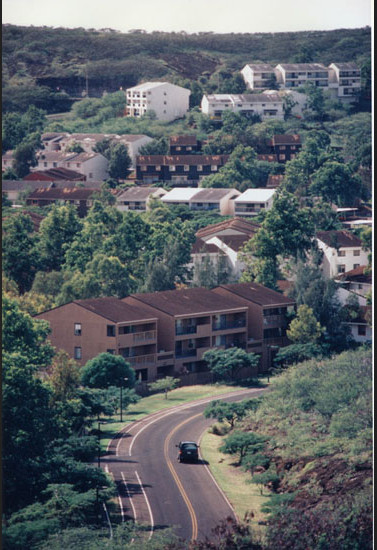

Did you come here because you were looking for your old AMR home on Google Maps and can’t find it? Do you think it might be missing, or that your old neighborhood doesn’t look quite right?
Let me reassure you that you haven’t lost your mind! Everything in AMR really is different now, and here’s why.
First, a Brief History About the Crater
I lived in AMR during the early 1990s. Back then, nobody really knew too much about the crater’s history, but there were lots of rumors.
For instance, someone once told me the crater was bombed at the same time as Pearl Harbor, and that all the bodies were cleared out before they turned it into housing. Someone else told me it was once used for military training.
The real story is this: in 1898, our government established Red Hill Military Reservation (the northeast part of the rim), and had taken over the rest of the crater during the late 1920s. At some point during that time, a section of the crater was used to grow sugarcane, and one report says the sugarcane farm remained through the 1930s.
For many years, the crater was used by the Army and Navy for training and ammunition storage. In 1974, the government decided to build military housing in the crater, and awarded the contract to designer and architect Beverly Willis to oversee the project. Construction began in 1975 and housing was finished in 1978, which is when the first families started moving in. Floor plans and old photos of early AMR can be seen on the Beverly Willis Archive website.
Next, the Gradual Decline of AMR
I don’t remember AMR housing being too ramshackle, and I don’t recall my parents, neighbors, or anyone else complaining about major problems while we lived there.
Fast forward to 1996. That year, during Clinton’s presidency, Congress passed the Military Housing Privatization Initiative (MHPI). Its purpose was to improve the quality and condition of around 180,000 rundown military homes being managed by the Department of Defense (DoD) at that time—not just in Hawaii, but everywhere.
The government turned all military housing—including AMR—over to private companies that specialized in property management, and all the contracts came with 50-year lease terms. By that point, according to several residents, AMR homes were showing signs of serious wear and tear, and were in desperate need of repairs and attention.
By 2006, Army Hawaii Family Housing (AHFH) was responsible for overseeing all AMR property and maintenance services, but apparently nothing was being addressed. AMR homes continued to fall into decline despite the new MHPI in place. News reports began surfacing about AMR homes being generally uninhabitable on behalf of problems like black mold, pest infestations, and similar issues.
In an attempt to save face, Janine Lind, the property management director of AHFH at the time, publicly stated in regards to mold problems, “Before privatization, the Army never did anything about it.” That’s quite a bold statement to make, Janine. Are you sure you’re not projecting?
In August 2010, AHFH rebranded itself as Island Palm Communities (IPC). Today, IPC continues to oversee and manage AMR and many other Hawaii military housing communities.
Then Came the Bulldozers
By around 2007, the government had finally drawn up plans to demolish the old AMR homes to make way for more modern, functional homes and communities. At that point, it was simply cheaper to knock down the older homes built in the 70’s and replace them with newer counterparts.
Between 2008 and 2013, IPC published several updates about construction taking place in AMR and other Hawaii military communities. Each separate AMR neighborhood and “village” such as Rim Loop and Valley View was completely torn down in phases, and families moved into the new homes as they were completed.
And that’s pretty much the story.

Hawaii Military Housing is Still Not Great, Apparently
Today, many military families stationed in Hawaii are still dealing with serious mold and pest infestation problems in their homes that aren’t being addressed, according to this impressive and heavily sourced report in Honolulu Civil Beat.
The article implies that the MHPI was simply an easy, convenient, and inexpensive way for the government to solve the country’s military housing problem and relinquish all accountability. It also adds that today, a whopping 70% of military personnel in Hawaii choose to live OFF base because the housing is so terrible. That really sucks.
It isn’t only military housing in Hawaii that deteriorated under the MHPI. In early 2020, the Government Accountability Office (GAO) called for an audit into DoD’s oversight of privatization amid countless reports of mold and pests including rats, maggots, and cockroaches.
Reports reveal that not much progress was made to improve military housing while Biden was president, so the work continues. An audit from September 2025 shows that many military homes are STILL being occupied despite posing serious life, health, and safety hazards. It also reveals that private housing companies are being mistakenly overpaid and incentivized, and that our government is losing millions to private companies that aren’t doing anything to help.
AMR on Google Maps: Then vs Now
At first glance, the crater looks the same on Google Maps. It’s only when you zoom in to find your house and street that you realize much of it is gone, or different. Some of the main streets look unchanged, but I lived there as a kid in the early 90s, so it’s difficult to remember things exactly how they were.
I lived on Acacia Place, in a long, boxy 2-story building that housed five units (A, B, C, D & E).
Here’s a snapshot from around 2004 of my old neighborhood, from Google Earth Pro.

Looking at Google Maps today, my house would be sitting smack-dab in the middle of Center Street if they had built around it.

Also, I don’t think Okamura Street existed back then—I would have remembered that clearly, because it was also the name of my 2nd grade teacher over at Aliamanu Elementary.
Final Words
I’ll admit, it was pretty upsetting to see that my old AMR home was torn down. Growing up as a military brat who never really had a dedicated home, this felt like extra salt being jammed into a wound.
People like to say memories last forever, but I disagree. Sometimes you need a little help jogging your memory, which is what I was counting on when I pulled up Google Maps to look at AMR.
Anyway, how cool is it that we can tell people we used to live at the bottom of a volcano crater?
I loved those days, living in the crater. I can close my eyes and see myself walking across whatever Okamura was called back then to get to the rec center. I’d always stop at the tadpole creek to see what was going on before going for swimming lessons, racquetball, or whatever else was going on back then.
If you were a military brat who lived in AMR, you may want to check out this Facebook group for fun. It’s geared toward AMR kids who lived there during the 80s and 90s. It’s a treasure trove of nostalgic photos from the “old crater” days, and you may just reconnect with old friends and neighbors!
If you have anything to add to this blog post, any fun history or related stories, feel free to drop them in comments. I’d love to hear them, and I’m sure others who find this page would appreciate it, too!
Last Updated on March 15, 2026 by Sarah
Leave a Reply